

By Anna Nelson | The Quality Line
If you fish Pacific cod in the Gulf of Alaska, you don’t need another headline to tell you something is off. You feel it in the openings that don’t pencil out. In the year classes everyone expected to see that just… don’t. In the growing gap between what the models suggest and what actually shows up on the grounds.
For years, fishermen have been adjusting to that uncertainty with very little explanation beyond “poor recruitment.” That phrase gets used so often it almost stops meaning anything.
A new study highlighted by NOAA Fisheries doesn’t fix that problem. But it does help explain where some of those fish may be getting lost, and why the impacts show up years later, often without warning.
The key is this: the trouble may be starting long before cod ever become fishable. Long before surveys. Long before management decisions. Back at the larval stage, when survival is decided quietly, underwater, and mostly out of sight.
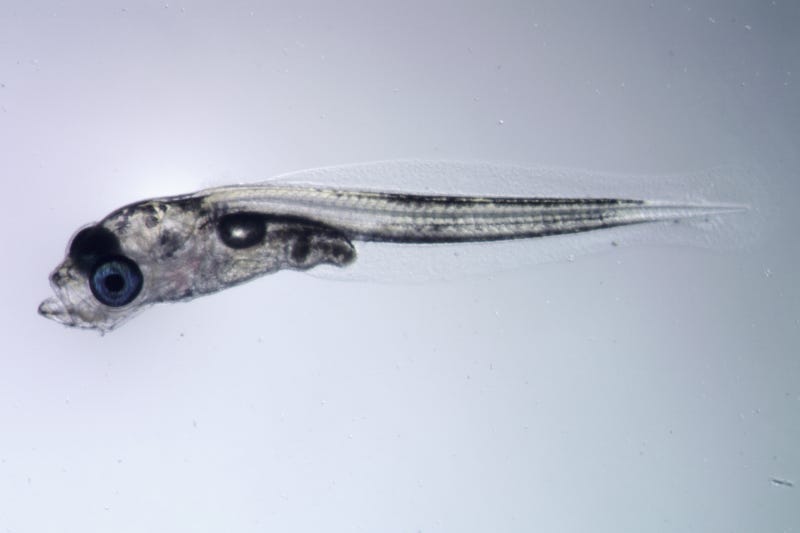
What’s happening to cod before anyone can count them
The research NOAA is pointing to — a new study published in Canadian Journal of Fisheries and Aquatic Sciences — focused on Pacific cod larvae, the earliest life stage after hatching. These fish are tiny, fragile, and living on a limited energy budget. Most will not survive even in good years. That’s normal.
What matters is that small changes in survival at this stage can translate into huge differences later, when those fish should be recruiting, or becoming fish we can actually catch.
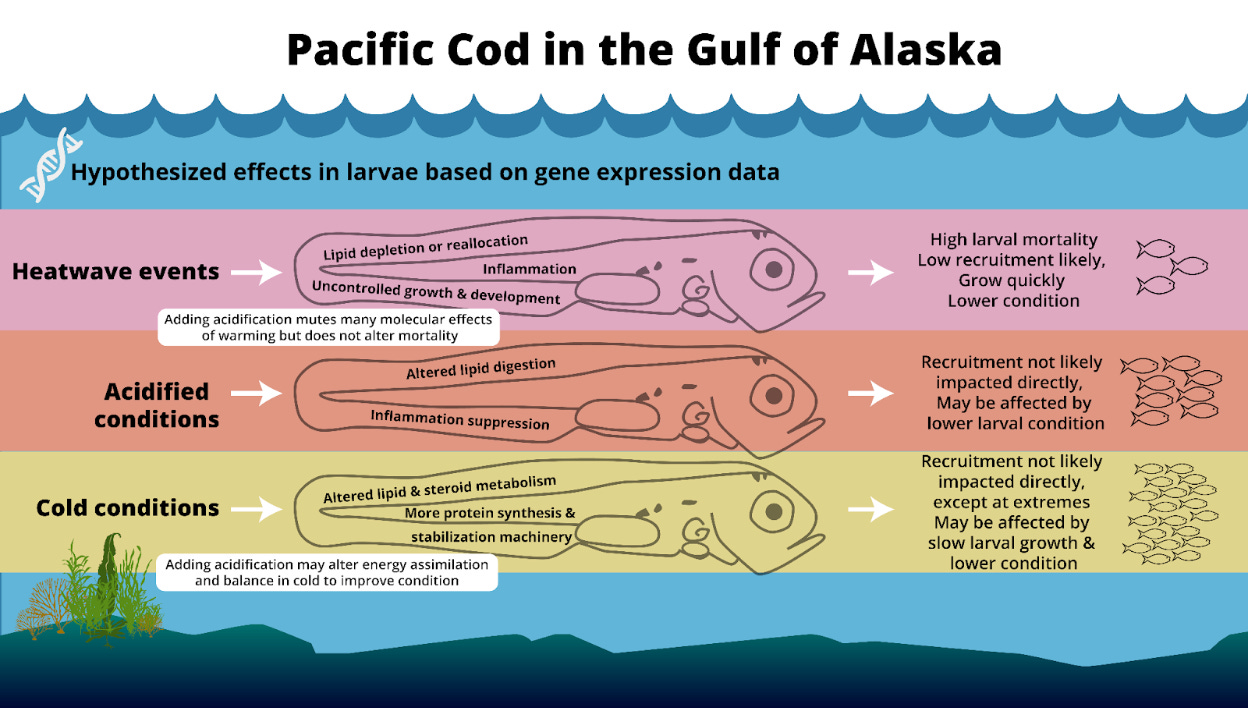
To understand what might be happening, scientists looked at gene expression, basically which biological systems inside the larvae turn on or off under different ocean conditions. Instead of guessing which stressors matter most, they watched how the fish actually responded.
They tested two conditions the Gulf of Alaska already experiences: cold temperatures and ocean acidification.
The results were not what many people expected.
Cod larvae appear to be relatively well-equipped to handle both. Their genes activate pathways that help regulate metabolism, maintain internal balance, and keep core cellular functions going. NOAA was careful to point out this doesn’t mean acidification is harmless or irrelevant, but it does suggest it may not be the primary reason cod larvae are failing to survive right now.
That alone is important context. Ocean acidification has often been treated as a catch-all explanation for early life-stage problems. This study suggests the picture is more complicated.
The real shift shows up when warming enters the equation.
Why warming changes the math for survival
When researchers exposed the larvae to warmer temperatures, their internal response changed in a way that caught NOAA’s attention.
Instead of focusing energy on growth and development, the larvae shifted into stress mode. Genes associated with inflammation became more active. Metabolic demand increased. The larvae burned through their limited energy reserves just trying to stay alive.
NOAA described this as a potential tipping point. The larvae are not immediately killed by warming, but the cost of coping becomes so high that they run out of energy before they can grow.
For fishermen, this framing matters. It helps explain why warming doesn’t need to be extreme to have serious consequences. A modest increase at the wrong time, during a narrow developmental window, can quietly remove fish from the system.
And those losses don’t show up right away.
Larvae struggling today would have entered the fishery several years from now. When surveys come back weak or quotas drop, the cause may trace back to ocean conditions from half a decade earlier.
This is one of the hardest things to live with on the water. You’re reacting to outcomes shaped by events you never saw.
As one skipper put it, “By the time we know something went wrong, the fish are already gone.”
The NOAA write-up makes clear that this delay is not a failure of monitoring. It’s a feature of fish biology.

Why this hits small fishing families first
Large fleets can spread risk across fisheries, regions, and balance sheets. Independent fishing families usually can’t.
When cod recruitment falters, it shows up immediately in household income, crew jobs, and the stability of coastal communities. There’s no cushion. No easy pivot.
This study reinforces something many fishermen already understand, even if it hasn’t always been acknowledged in management conversations. The future of a fishery is being shaped by forces far outside the wheelhouse. Survival decisions are happening before the fish are even juveniles, let alone legal size.
That doesn’t mean management doesn’t matter. It does mean expectations need to line up with biological reality. Systems built around the assumption of stable recruitment year after year are increasingly out of step with what the ocean is doing.
NOAA’s decision to highlight this research is telling. It signals a growing recognition that recruitment failures are not always the result of overfishing or poor behavior on the water. Sometimes they are the result of larvae burning through their energy budgets in a warming ocean, never making it far enough to be counted.
For fishermen who feel blamed when stocks decline, that distinction matters. It shifts the conversation from fault to context.
This study doesn’t say Pacific cod are doomed. In fact, it highlights their resilience to cold and acidified conditions, which is encouraging. But it makes clear that warming introduces a different kind of risk, one that quietly increases mortality years before fishing ever begins.
For fishing families, the takeaway isn’t comfort. It’s clarity.
If recruitment is being shaped long before anyone sets a net, then conversations about resilience, management, and adaptation need to start there. Fishermen deserve that context when seasons shrink or quotas drop. And they deserve a system that recognizes how much of this is happening beyond their control.
The science is finally catching up to what fishermen have been seeing on the water.
What are you noticing where you fish? Are recruitment changes showing up in cod, or in other species as well? We’d like to hear how this looks from your deck.
Anna Nelson is a business and grant writing consultant specializing in commercial fishing businesses. She works with independent fishermen, fishing organizations, and seafood stakeholders to develop strategies for sustainability, market access, and industry resilience. Anna is the curator, editor, and one of the contributing authors to The Quality Line.